8.6.09

Tracking Naheeda, the Pathan Village Woman

Tracking Naheeda, the Pathan Village Woman
by Farzana Versey
State of Nature

Salim’s house had a large blue gate. He rang the doorbell and a small slat was opened. Clothes were drying. Large water tanks took up most of the front space. A pretty young girl, his sister, peeped out. Inside the houses, women only cover their heads with a dupatta (scarf); they are not concealed behind a burqa (veil). An elderly relative brought it out for me and demonstrated how it was worn, laughing at the ridiculousness of it all. This is what amazed me -- she found it funny.

There were three young girls in the house. Fahima was to be married soon. Ali, the brother, was lounging on a coir cot when I entered the room; he said he would miss his sister. She had not met her husband-to-be. Wasn’t she worried? Did she have no expectations? She giggled, which is when Ali intervened and said, ‘A girl has it better than us. In the street, if there is an older woman with her who has seen the boy, then he is pointed out, so even through the burqa she can see what he looks like. We men are not so lucky.’

* * *

The room had a television set, a music system, and fine crockery; they were a comfortably-placed family. There was a basement to keep them cool in summer and warm in winter. I was allowed to take pictures. The father had even granted his daughters permission to have their photographs taken, but they were too shy. Endless cups of green tea, like mossy liquid, were served. There was no chariness that Salim and Ali were chatting so openly with me, sitting cross-legged on a cot. Both the brothers liked their free-spirited young aunt, Naheeda.

We went to her house a few doors away. The chachi (paternal aunt) truly turned out to be quite an unusual creature. She had been educated in Islamabad. How did it feel to move to Peshawar? Was there a cultural difference? She spoke with a remarkable degree of confidence. ‘Initially, I could not understand some things, but now it is better. I do not wear a burqa even when I go out, so people have become used to it now and they don’t care. I also insisted on planning my family, or else in these seven years I would have six kids…now I have three. People here like to have children around the house.’

She smiled indulgently as a naked little one, the youngest, kept jumping on the bed. We sat in a small, dark, unkempt room. There were some Afghani rotis (bread) and curry in an aluminium bowl on a table; the older children would occasionally tear large chunks of the bread and dunk them in the gravy, holding the rag-like bits over their open mouths as the liquid left trails of speckled brown on their chins. Naheeda shooed them away.

She had not let childbirth and housework mar her looks, although some chubbiness had settled on her cheeks and chin. Her head was uncovered and her black hair was tied in a loose braid. ‘I want to work too, but I get no time. The schools are far, so I have to drop the children there. Women rule in the house. If I were under any restrictions, do you think I could talk to you in privacy? My husband is there praying, he could have stopped me.’ Just then he called out to her. She returned within minutes. ‘He has asked me not to let you leave without having lunch with us. He has to remind me to be a good hostess, I just talk so much that I forget basic manners.’ And what happened to the education she had acquired? ‘In future I don’t know, but for now my children will benefit. And it shows in the way I conduct my life. No one can boss over me.’ While her husband and mother-in-law were busy with their afternoon prayers, she did not feel it necessary to join them.

I had to leave. ‘If you cannot eat with us now, come later. Check out of the hotel, stay with us, it is safer here. There people will wonder. Here we can protect you.’ I felt truly humbled by such a spirit of acceptance.

Three years later…

I was greeted warmly by his mother. Two young women I had not met before came out. Both Salim and Ali were now married. Salim was the father of a two-year-old boy. Their quarters were on the first floor. These had been constructed to give them privacy and more space. They shared a common bathroom, but their rooms were different. Salim’s wife had brought along silver-plated jugs and plates; they adorned a glass showcase. The bed had a red velvet spread over it. A sofa and chair upholstered in suede were against the other wall. Ali's room had glass crockery and a printed bedsheet.

These were gifts the wives had got from their parents. Salim’s mother assured me that if it reflected any disparity, it was more to do with how the girls’ families wanted them to live. Below, the hierarchy ceased to exist. The younger daughter-in-law was openly curious. She asked me about India, the big cities, people, and films. Salim’s wife stood silently. Being older and richer was her psychological advantage.

‘How is your aunt Naheeda?’ I asked Ali about the woman he had admired so much for her rebellious spirit.

‘She wears a burqa now,’ he stated without emotion.

She wasn’t there, so we could not meet. I wanted to know more about her. Ali was a reluctant raconteur. Unlike earlier, he did not sit with us. We were in the same room I had sat in three years ago. The coir cot now had foam mattresses. The glass-fronted shelf housed a model of the globe, two cups and saucers, a showpiece that arched towards an egg-shaped bowl. Perched on it, rather incongruously, was a pair of Ray Ban glasses.

I did not find any religious motifs. Salim’s mother volunteered the information I was seeking. ‘We keep those inside.’ She turned her hand upwards and then touched her heart. Her God lay within.

Our non-verbal communication interspersed with monosyllables conveyed much more than sentences would.

Naheeda continued to intrigue me in her absence. I asked Salim about her. ‘She gives tuitions to the children in the neighbourhood.’ Nothing could stop her and nothing did. The veil was just another garment, I reasoned.
* * *

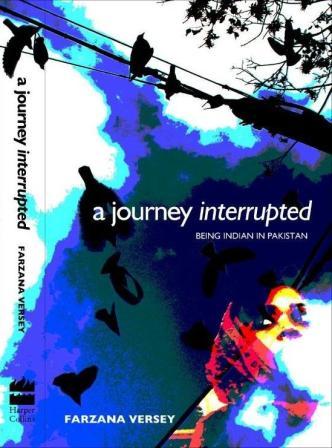
(This is an extract from ‘A Journey Interrupted: Being Indian in Pakistan’, Harper Collins, India.)


7.6.09

Reader views

Still getting responses...

Dear Ferzana,

I wanted to read your wonderful book once and "study" it a second time before writing to you.

First reading fascinated me. The way you have, after starting off as a travelogue, weaved history of a period that I have been conscious of is superb.

You did manage to meet, talk to and interview a whole range of personalities from almost every walk of life I enjoyed reading the book. Thank you.

A word about Lahore. I have never visited it but have seen many friends who migrated from Lahore to Delhi. They are very proud of their being "Lahorians". It was the best cantonement of undivided India. It also boasted some of the best colleges. I suppose you know that the film actor Dev Anand and his wife Kalpana Kartik (Mona Singha) are from Lahore. Her sister Sona was the wife of one of my bosses in service. And her brothers were in the armed forces. One of them, an Air Force officer got married to the daughter of the police commissioner of Lahore. I met the chaming couple when they spent (a part of) their honey moon in a tent in Doraha in Punjab. I used to enjoy the chilgozas she would pass around sitting on the canal bank. I do not know if the Air Force got him to take premature release because I never heard of them afterwards. What I started out to say to you was that Lahorians being a little snobbish is forgivable.

In the second reading I was "reading" more the author than the contents.

First, I admire the courage (once or twice bordering on foolhardiness which just happened to pay off without getting you into trouble) you showed in making your trips and organising meetings.

Your intellect I shall not comment on for fear of getting branded as a flatterer. However, I was surprised to find that occasionally acted so naive!

Sensitive you have to be to be what you are. Sensitivity and intelligence go together. What i had not noticed earlier is the insecurity you inwardly feel. Of course many of my muslim friends in Bombay feel slightly insecure because they were touched though remotely in the riots sponsored by our Hindu extremists ("terrorists" ?) I do not know your or your familiy's direct experience in that context. But the feeling of your insecurity hurts me.as a human being, not as a Hindu because I am virtually an athiest - or "rationalist" as I would prefer to be called. If there is insecurity, there must be a solution somewhere!

- (Rt. army officer, now living overseas)
- - -
Dear Farzana,

I just finished reading your "Journey".

What can I say? I am speechless. It is so exhaustive.....history,politics,sociology,economics, people ranging from the poorest to the grandest, poets to dancers, gays to lusty hetero's,military to the artistes.

Tears sprang in my eyes when I read of your hurt at the Wagah border callisthenics.

The 3 books that seriously affected me have been ...Dosto's' Crime and Punsihment', Camu's 'The Fall', Kafka's 'The Trial' and Capote's 'In Cold Blood'. But then there are so many of them out there that I have read and deeply enjoyed. But the books I have mentioned are embedded in my heart.

And now your book. This one too has not only clasped and embraced me tightly it has already begun engraving herself ( I cannot use 'itself' ) in my very soul.

I must thank you for so lucidly informing and educating me on Pakistan. I could talk to you for hours and hours on the Partition and the new State and the never ending tragedy unfolding repeatedly year after year and day after day. These are flames that can consume so many for absolutely no reasons whatsoever.

'Rajhish hi sahi...'is saved in my iTunes library and never fails to stir me. Once again one of my favorites and you interview the Great Faraz himself in your book.

I admire you for your sensitivity, astuteness and courage.

Yes I have questions, maybe a couple of disagreements also.These are triflings...... but ultimately my heart beats for what you write in this book.

(India)

12.5.09

Before the Taliban: Memories of Peshawar

(This is an extract from 'A Journey Interrupted: Being Indian in Pakistan', Harper Collins-India.)

Before the Taliban: Memories of Peshawar
by Farzana Versey
Countercurrents, May 12,2009

As the city is on edge, and friends are being seen as enemies, I want to share recollections of the times I spent in the capital of the frontier province on the trips I made to Pakistan since 2000.

* * *

We were hungry. I told Salim, my guide, I wanted to eat at an authentic Kabuli restaurant. Breads were being baked on upturned woks. The place was packed. I was the only woman in there. A scraggly-looking man came up to us and parted a curtain; the few men having their meal immediately got up and moved out without a word. Chivalry was unspoken and not brandished with a flourish.

The sofa felt wonderfully comfortable after the long drive. The moment I raised my eyes I found (Indian film star) Ajay Devgan staring at me. Stuck on the wall, his photograph typified the Afghan obsession with Hindi films.

We had a hearty meal. There was a stew, some barbequed meats and sautéed vegetables. The food did not leave you feeling full, cooked as it was with a touch so light that even flesh had a feathery texture. Bowls of yoghurt served as dessert.

Driving back to the city, we passed another route. This was Hayatabad; it was called the mini Islamabad due to its well-structured houses, trees peeping out of high walls, bursts of floral colour in the balconies. The inhabitants were invisible. Who were they? Salim explained, ‘Mainly Afghans, the ones who have made it big. But they can only rent the houses, not buy them. There are two million Afghan mohajirs here, so they say Peshawar should be theirs.’ But what about the guns and drugs? ‘The problem is that Pakistani laws do not extend beyond Torkham, so our government can do nothing. If they commit a crime, our rules do not apply.’ Yet there is sympathy for them in many quarters. ‘Our hearts are with them, though our minds may not be.’

It was difficult to understand how the Pathan heart could even fathom a jihad against the Russians – was it an Islamic jihad they were supporting or an American one? Salim sounded genuinely concerned: ‘The Afghans do not have it easy. They have to work hard to make money. They may be a burden for the rest of Pakistan but not for the Pathans.’

Next day I promised myself I would explore the question that had been left unanswered.

* * *

When you enter the smuggler’s market in Bara – the other being Jamrud – it is not glitzy. Alleys lead to pale buildings greying at the edges; flies squat on plump fruits in so relaxed a fashion it might seem as though a durbar was being held to squeeze out every drop of juice You get everything here, except maybe cars, said Salim. When we arrived, it was fairly early in the morning, people were still getting their shops ready. Some were fanning the dhuan (thick incense sticks and coal pieces burning in a small copper pot) to ward off evil, even as under the table there might have been some devious items they would sell.

There were carts outside with Korean toys, Japanese gizmos, sweets, green tea, spices, but it was essentially a cover-up. The real stuff was what could not be seen. I tried to understand the gun culture. Was it so easy to get arms? Apparently, it was. If the Pakhtoons have benefited, it is by getting weapons, corroded rifles left by the Russians. Interestingly, the Afghans want to appear more respectable and are preoccupied with beautifying their homes and fitting them with the latest amenities.

The mujahideen, as they came to be called assuming they were ‘holy warriors’, were above the law. Primarily because they came in handy for Pakistan’s Inter Services Intelligence, the ISI, that trained and armed them. It must be remembered that the country had to deal with a huge refugee problem after the Afghan War. Most of those who crossed the border chose to stay in the frontier regions even after the war was over. And this was seen as an ideal give-and-take deal. Besides, the drug trade of the Afghans is diverted via Pakistan so again there is a mutual need. There are several contradictions. While Pakistan has to keep an eye on the Pathans in its armed forces, it got caught in the Afghan problem. Salim mentioned how some youngsters would go back home to avenge the death of a family member or a rape or the destruction of property and return to Peshawar to work and make money, often to sponsor another vendetta. It is said in these parts that every Afghan is a mujahid.

Salim’s family is an old one, where things like education matter. There are others who have homes in Peshawar but choose to live in the more mainstream cities.

This is in sharp contrast to the widely-travelled and suave Waquar’s brother who retains the Pakhtoon stamp, choosing to live in the village. In a sense, the tribal identity was a cocoon against a communist Afghan regime next door. For the Pathans, military rule in the rest of Pakistan does not count; they feel they are on a cusp.

* * *

We enter the university town with its neat avenues. The red brick façade of the 70-year-old Islamia University is awe-inspiring. Water fountains and perfectly-lined trees, like obedient students, dot the landscape. Salim is doing his post-graduate studies here. He looks like a nerd. A small, built-like-a-boy Pathan, he wears steel-rimmed glasses. What would education mean to him in the given context? ‘It is a personal choice. This car too is mine, it does not belong to the hotel. I work as a tourist guide because that too is knowledge for me. I try to speak in English to improve mine. And this broadens my world. I don’t want to go out and earn big money, but I want to be equipped to improve things here. I will marry the girl chosen by my parents and it will be early, but it will also give me a sense of security.’

He takes me to a bookshop where there are volumes of Osama Bin Laden’s biography. This was pre 9/11, so that is the only place I saw his face. I picked up a copy and was riffling through it when the shopkeeper came up to me and said, ‘It is okay only if you are interested in the man. Otherwise it is useless.’ This was in the heart of Pathan territory, which was to later display complete loyalty to this man. I was told instead to look for books by Khushal Khan Khattak. He and Khan Abdul Ghaffar Khan are the true representatives of Pathan culture, Salim tells me. One is at the traffic signal, a statue in bronze, the view impeded by a lamp-post, the other ‘not available’.

The Khan Abdul Ghaffar Khan factor is more complex. In India he is remembered as Frontier Gandhi. How did a man who founded the Khudai Khidmatgars, in the spirit of a Sufi asking men to serve god to quell the religious fundamentalism that was becoming politics, fit in here?

He did not. His politics was probably as divisive as that of many other mainstream leaders. ‘God’s servants’ tried to emulate Communism and brought the Afghans in. For him, Partition was not about India and Pakistan, but ‘Pashtoonistan’. His eldest son Wali Khan had once said, ‘We have been Pathans for 3,000 years, Muslims for 1,000 and Pakistanis for 40.’

Until almost a decade after Partition, Peshawar remained a fortress enclosed behind sturdy walls and 16 gates. The Afghan War, ironically, made ‘Pashtoonistan’ a forgotten dream recalled only when Ghaffar Khan, died having left instructions to be buried in Jalalabad, not Peshawar.

Salim does not know that a map had been drawn, flags been designed for this separate state. But even to an outsider, he introduces himself as a Pathan, not a Pakistani.

3.11.08

Review in Swagat

This is a review that has appeared in the November 2008 issue of Swagat, which is the inflight magazine of Indian Airlines. Their website says it is read by 2 million upmarket passengers every month. But they will still read Paulo Coelho da jawaab nahin!

As with all reviews, I shall not comment, except to clarify that nowhere have I mentioned that Aga Khanis are a persecuted lot in Pakistan.


12.10.08

Pakistan visually....

They say pictures speak louder than words. I don't know...some do, others are there to convey a moment.

Those who have read my book A Journey Interrupted: Being Indian in Pakistan will be familiar with some locales. Most of these photographs have been taken in May 2007; there are a few that are from the summer of 2004.

On the earlier trips I had not used a digital camera and many, many more need to be scanned.

Until then, here is what I have managed to upload...most are not about 'sights', as is evident even in my book.

28.9.08

Review in Deccan Herald

Negotiating for an identity
Deccan Herald


What begins as an exciting concept soon descends into confused dialogues and reflections. A Journey Interrupted becomes an opportunity interrupted. Farzana Versey embarks on a unique journey, as an Indian in Pakistan. But what makes her journey unique is that she is not only Indian, but an Indian Muslim and so, much information not easily accessible to many Indians becomes accessible to her. She takes the reader with her to Karachi, Islamabad, Lahore, Peshawar and many other interesting and unique places, some known, others little known places.

The book tries to give as complete a slice of Pakistani society as possible, without any obfuscation no matter how disconcerting the narrative and introduces an array of interesting personalities. So when the Karachi teenagers tire of pornographic sites, they ‘visit Indian sites. There are fights about Indo-Pak issues...and Kashmir is top in the list; then we discuss films, cities and politics.’ UK-based Sikh Satwinder, is rebuilding his father’s lost-in-partition empire in Lahore, ‘...his way of hitting out, telling Lahore that he is rebuilding his father’s life’; Shujat, wants to have an affair with ‘Not just an Indian woman, but a Brahmin one’, which would not be ‘about love, but hate...like war’; Tariq thinks ‘..the Hindu is a stigma for Muslims, anyway, they are definitely not seen as the same as us’.

Against them is juxtaposed Jeremy, the Christian, who does not care that he cannot discuss Christianity in social gatherings like Islam is discussed, so long as ‘I am allowed my drinks, I carry my name and I go to church...’, Nihal, who wants a break in Bollywood for ‘Bollywood is the place to be, even our established actors want to make it there.’

Khalid Ahmed, in charge of the ‘Beyond Borders’ concept in Pakistan, who, born in Patna came to Pakistan as an adult and carries all these — ‘a Bihari identity, an Indian identity and a Pakistani identity’. Sheema Kerwani ‘dances in a society where she is not permitted to, to the strains of Indian music in a form that was created as a celebration of Hindu gods. But for her Lord Krishna is not just a clay idol, but a vision of love...’. For Ardeshir Cowasjee, ‘a motherland is a motherland. If I am asked where I was born, I would say India. In 1929, this was India’. And Parvez Hoodbhoy, who rejects that there is a Pakistani culture and sees a ‘deliberate attempt to ‘Saudi-ise’ it, as opposed to accepting a South-Asian identity’.

The academician, the harlot, the delinquent juvenile mystic, the rich Sindhi Hindu, the gay, the lesbian, the Afghan refugee, the poet, the civil rights activist — all are touched upon.

There are some beautiful imagery and moments of reflection. And the author’s own journey through her many fractured identities — as a woman, an Indian, a Muslim, a Muslim in India, an Indian Muslim in Pakistan — ‘the emotional mulatto. The fence sitter who could not make up her mind. But when did I have a choice?’

The style at times is reminiscent of M J Akbar, but unfortunately the author is unable to sustain it and the reader’s interest. So it becomes an endless series of interviews culminating into analysis often defensive and judgmental. The incessant questions, the disjointed narratives and the constant refrain of the Babri Masjid demolition combine to dull the reading. There are also some sweeping and simplistic generalisations: ‘Unlike in Mumbai...in Pakistan a Parsi can at least die with his faith intact’, 'This was how the Hindu mind, the urban, western-educated mind was thinking’, and a sorry apologist argument about the blowing up of the Bamiyan Buddhas.

The ending is poignant; witnessing the ‘Beating the Retreat’ at the Wagah border on the Pakistani side, the author bursts into tears when she hears the voice of Lata Mangeshkar from the Indian side against the Pakistani backdrop of Allahu Akbar. “I could not explain. Allah-u-Akbar and Lata Mangeshkar are both embedded deep in my consciousness. Both are part of my personal history.” These lines convey the message that the rest of the book struggles to. All the challenges, the contradictions, the anger, the pain and smugness of being a Muslim in India come gushing forth. So while A Journey Interrupted leaves one with insightful vignettes of Pakistan, its tortuous tryst with its identity-based destiny, the book is also about the author’s attempt to negotiate her own identity.

"we do not 'need' peace with Pakistan": FV interview

Author Of The Month: August: Farzana Versey


In an email interview to Dhvani, Farzana Versey talks about her book A Journey Interrupted: Being Indian In Pakistan

Q: I think your book in ways tries to say that, "Yes we have our differences but let's leave out the politicians and begin the peace process." Comment.

A: The 'leave the politicians out' bit is right, but I don't see why we need to start the peace process. Such processes are in fact a political agenda. Socially, we do not 'need' peace. We just have to get rid of this anguish about a lost land. No one asks us to start the peace process with Nepal or Sri Lanka or even Bangladesh. And we do have political turbulence with these nations. So, why Pakistan?

Q: How was the response to this book in Pakistan?

A: They are still waiting for it! But after reading my interviews and a couple of extracts, some Pakistanis have written to me to say that I have rubbished their country. It is not true and a rather simplistic reading; it is like saying that when I critique a poem, I dislike poetry. Yes, a few expat Pakistanis have read the book. Some have picked holes and asked why I did not have paan at a landmark place and someone else wants to know why I am obsessed with Gandhi when I don't even like Gandhi....There was an unusual opposite reaction from another Pakistani who said, "Why do you not like that poor man?" I could only say, "It is because I do not like poor people!"

You haven't asked me about the response in India. I find that curious. It is written from an Indian perspective, in fact, far too much at times. I shall answer the unasked question anyway. I have got letters from small towns even before the book was formally launched. These are not just letters congratulating me. They have taken pains to point out page numbers and what those words there meant to them or in some cases did not mean. This is immensely gratifying for what people would call non-fiction. It reads like fiction, I am told, and it only buffers the cliche that truth is stranger than fiction.

Q: In A Journey Interrupted, is there a hint of a nation interrupted? Does your being an Indian take the taste out of the peanut butter?

A: If we use the Charles M. Schulz quote, "Nothing takes the taste out of peanut butter quite like unrequited love", then let us just say that which was 'unrequited' was mutually so! To talk about the 'nation interrupted' would mean having epic ideas. I prefer the minutiae. It is true that Pakistan is in denial just as much as India is. But Pakistani denial is more obvious.

Q: Do you think the Indo-Pak conflict has begun to lose relevance when so many singers, actors and models are making a mark in the Indian Film Industry?

A: How many? Where is Meera? And I do have strong reservations about why they can make it here - at least the singers - and we cannot. How many of our singers have performed there? It seems like we let them participate in our music shows, it is entirely possible that it is a strategy for TRPs. Do we realise that it makes Pakistan, our neighbour and supposedly close to us in cultural terms, seem like Mogadishu. This is weird.

Q: You write blogs too, does it give a sense of freedom, to be easily politically incorrect.

A: I have always exercised my ability to be politically incorrect, whichever forum I choose to express myself in. I don't think we should have different standards for writing. A doctor uses the same instruments whether s/he is performing a surgery at a private or public hospital, right? A writer should follow the same principle. The technique for an article may differ, but in my case that too applies rarely. Blogs only give me an opportunity to indulge my vanity a bit more.

Q: Do you have feeling that in India there's a double identity conflict? One is that of the faith and the other is class? Consider this statement by Shah Rukh Khan, "My success is a biggest proof that India is secular."

A: India has multiple identity crises, but if we restrict it to one community then faith and class do come into play. A Shahrukh Khan can talk about his success being the proof of secularism because that is the yardstick - achievement. If Shahrukh Khan did not live in a mansion and was resident of Behrampada doing odd jobs then he would be just a number (and I do not mean Number One). I find it odd that we still have to talk about proof for secularism. This is a sign of insecurity.