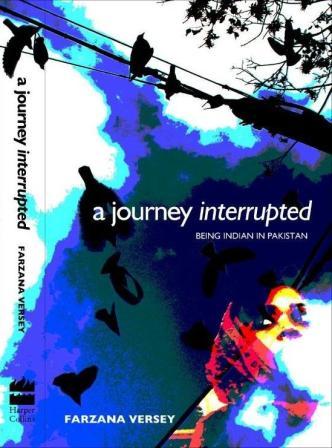
Still getting responses...in the mail and posted elsewhere
Dear Ferzana,
I wanted to read your wonderful book once and "study" it a second time before writing to you. First reading fascinated me. The way you have, after starting off as a travelogue, weaved history of a period that I have been conscious of is superb. You did manage to meet, talk to and interview a whole range of personalities from almost every walk of life I enjoyed reading the book. Thank you.
A word about Lahore. I have never visited it but have seen many friends who migrated from Lahore to Delhi. They are very proud of their being "Lahorians". It was the best cantonement of undivided India. It also boasted some of the best colleges. I suppose you know that the film actor Dev Anand and his wife Kalpana Kartik (Mona Singha) are from Lahore. Her sister Sona was the wife of one of my bosses in service. And her brothers were in the armed forces. One of them, an Air Force officer got married to the daughter of the police commissioner of Lahore. I met the chaming couple when they spent (a part of) their honey moon in a tent in Doraha in Punjab. I used to enjoy the chilgozas she would pass around sitting on the canal bank. I do not know if the Air Force got him to take premature release because I never heard of them afterwards. What I started out to say to you was that Lahorians being a little snobbish is forgivable. In the second reading I was "reading" more the author than the contents.
First, I admire the courage (once or twice bordering on foolhardiness which just happened to pay off without getting you into trouble) you showed in making your trips and organising meetings.
Your intellect I shall not comment on for fear of getting branded as a flatterer. However, I was surprised to find that occasionally acted so naive! Sensitive you have to be to be what you are. Sensitivity and intelligence go together. What i had not noticed earlier is the insecurity you inwardly feel.
Of course many of my muslim friends in Bombay feel slightly insecure because they were touched though remotely in the riots sponsored by our Hindu extremists ("terrorists" ?) I do not know your or your familiy's direct experience in that context. But the feeling of your insecurity hurts me.as a human being, not as a Hindu because I am virtually an athiest - or "rationalist" as I would prefer to be called. If there is insecurity, there must be a solution somewhere!
- (Rt. army officer, now living overseas)
- - -
Dear Farzana,
I just finished reading your "Journey". What can I say? I am speechless. It is so exhaustive.....history,politics,sociology,economics, people ranging from the poorest to the grandest, poets to dancers, gays to lusty hetero's,military to the artistes.
Tears sprang in my eyes when I read of your hurt at the Wagah border callisthenics.
The 3 books that seriously affected me have been ...Dosto's' Crime and Punsihment', Camu's 'The Fall', Kafka's 'The Trial' and Capote's 'In Cold Blood'. But then there are so many of them out there that I have read and deeply enjoyed. But the books I have mentioned are embedded in my heart. And now your book. This one too has not only clasped and embraced me tightly it has already begun engraving herself ( I cannot use 'itself' ) in my very soul.
I must thank you for so lucidly informing and educating me on Pakistan. I could talk to you for hours and hours on the Partition and the new State and the never ending tragedy unfolding repeatedly year after year and day after day. These are flames that can consume so many for absolutely no reasons whatsoever.
'Rajhish hi sahi...'is saved in my iTunes library and never fails to stir me. Once again one of my favorites and you interview the Great Faraz himself in your book. I admire you for your sensitivity, astuteness and courage.
Yes I have questions, maybe a couple of disagreements also.These are triflings...... but ultimately my heart beats for what you write in this book.
(India)
---
Although the book is based on author's 4 travels to Pakistan between August 2001 and May 2007, it is not a travelogue, says the author and rightly so. Unlike travelogues, people (known, unknown, blurred) are the subjects of the book, not places; latter merely provide the backdrops.
The book does not have a single photograph from any of the four travels, which underscores the fact the it is not about places or even faces, but views. The reader does get a feeling of the journeys being narrated. The narration is so engaging that the author swiftly embeds anecdotes to factual details without disrupting its pace.
The author has been able to include Manto's memories with the same ease as her meeting with Ahmad Faraz. Apart from Faraz, the readers get rare opportunity to know up close some other well known names like Ardeshir Cowasjee, Pervez Hoodbhoy. However it's the unknown names (till you read the book) like Saqlain, Bilal, Shujaat, etc., who tell about that country, often without telling, what makes this book different. Conspicuous by its absence is any mention of Dr Abdus Salam. Besides, how could Pervez Hoodbhoy say "... There is no major Muslim scientist or ...". So, for him too, like many Pakistanis, Dr Salam was not a Muslim.
Author, no point in guessing, is the protagonist, besides being the narrator. How she is seen in Pakistan and her reactions to how India (and Indian Muslims in particular) is perceived by Pakistanis naturally makes her the protagonist. Her style of describing women is graciously sensuous and reminds me of Ismat Chughtai.
The book is an essential read, if one wants to read about Pakistsn as a person, not as a strategist or even a peace activist. I never imagined myself visiting Pakistan, but after reading the book, I may plan to travel to Pakistan as a curious traveler the day it starts issuing tourist visas to Indians, as I have neither relatives there nor I'm an Aman-ki-Asha activist.
Ayaz Alam
---
These are the fateful queries that partition raised and whose answer still haunts us! A lot has been written about identities whether Ethnic or Religious, but in this present book Farzana Versey raises some distinct and distinguished insights into this complex problem of identity. Though this book is neither a research work undertaken by the author under the auspices of a grand university and seasoned researcher nor is it a conventional travelogue, though one may find certain traits of travel writing in it.
Mushtaq, India
Dear Ferzana,
I wanted to read your wonderful book once and "study" it a second time before writing to you. First reading fascinated me. The way you have, after starting off as a travelogue, weaved history of a period that I have been conscious of is superb. You did manage to meet, talk to and interview a whole range of personalities from almost every walk of life I enjoyed reading the book. Thank you.
A word about Lahore. I have never visited it but have seen many friends who migrated from Lahore to Delhi. They are very proud of their being "Lahorians". It was the best cantonement of undivided India. It also boasted some of the best colleges. I suppose you know that the film actor Dev Anand and his wife Kalpana Kartik (Mona Singha) are from Lahore. Her sister Sona was the wife of one of my bosses in service. And her brothers were in the armed forces. One of them, an Air Force officer got married to the daughter of the police commissioner of Lahore. I met the chaming couple when they spent (a part of) their honey moon in a tent in Doraha in Punjab. I used to enjoy the chilgozas she would pass around sitting on the canal bank. I do not know if the Air Force got him to take premature release because I never heard of them afterwards. What I started out to say to you was that Lahorians being a little snobbish is forgivable. In the second reading I was "reading" more the author than the contents.
First, I admire the courage (once or twice bordering on foolhardiness which just happened to pay off without getting you into trouble) you showed in making your trips and organising meetings.
Your intellect I shall not comment on for fear of getting branded as a flatterer. However, I was surprised to find that occasionally acted so naive! Sensitive you have to be to be what you are. Sensitivity and intelligence go together. What i had not noticed earlier is the insecurity you inwardly feel.
Of course many of my muslim friends in Bombay feel slightly insecure because they were touched though remotely in the riots sponsored by our Hindu extremists ("terrorists" ?) I do not know your or your familiy's direct experience in that context. But the feeling of your insecurity hurts me.as a human being, not as a Hindu because I am virtually an athiest - or "rationalist" as I would prefer to be called. If there is insecurity, there must be a solution somewhere!
- (Rt. army officer, now living overseas)
- - -
Dear Farzana,
I just finished reading your "Journey". What can I say? I am speechless. It is so exhaustive.....history,politics,sociology,economics, people ranging from the poorest to the grandest, poets to dancers, gays to lusty hetero's,military to the artistes.
Tears sprang in my eyes when I read of your hurt at the Wagah border callisthenics.
The 3 books that seriously affected me have been ...Dosto's' Crime and Punsihment', Camu's 'The Fall', Kafka's 'The Trial' and Capote's 'In Cold Blood'. But then there are so many of them out there that I have read and deeply enjoyed. But the books I have mentioned are embedded in my heart. And now your book. This one too has not only clasped and embraced me tightly it has already begun engraving herself ( I cannot use 'itself' ) in my very soul.
I must thank you for so lucidly informing and educating me on Pakistan. I could talk to you for hours and hours on the Partition and the new State and the never ending tragedy unfolding repeatedly year after year and day after day. These are flames that can consume so many for absolutely no reasons whatsoever.
'Rajhish hi sahi...'is saved in my iTunes library and never fails to stir me. Once again one of my favorites and you interview the Great Faraz himself in your book. I admire you for your sensitivity, astuteness and courage.
Yes I have questions, maybe a couple of disagreements also.These are triflings...... but ultimately my heart beats for what you write in this book.
(India)
---
Although the book is based on author's 4 travels to Pakistan between August 2001 and May 2007, it is not a travelogue, says the author and rightly so. Unlike travelogues, people (known, unknown, blurred) are the subjects of the book, not places; latter merely provide the backdrops.
The book does not have a single photograph from any of the four travels, which underscores the fact the it is not about places or even faces, but views. The reader does get a feeling of the journeys being narrated. The narration is so engaging that the author swiftly embeds anecdotes to factual details without disrupting its pace.
The author has been able to include Manto's memories with the same ease as her meeting with Ahmad Faraz. Apart from Faraz, the readers get rare opportunity to know up close some other well known names like Ardeshir Cowasjee, Pervez Hoodbhoy. However it's the unknown names (till you read the book) like Saqlain, Bilal, Shujaat, etc., who tell about that country, often without telling, what makes this book different. Conspicuous by its absence is any mention of Dr Abdus Salam. Besides, how could Pervez Hoodbhoy say "... There is no major Muslim scientist or ...". So, for him too, like many Pakistanis, Dr Salam was not a Muslim.
Author, no point in guessing, is the protagonist, besides being the narrator. How she is seen in Pakistan and her reactions to how India (and Indian Muslims in particular) is perceived by Pakistanis naturally makes her the protagonist. Her style of describing women is graciously sensuous and reminds me of Ismat Chughtai.
The book is an essential read, if one wants to read about Pakistsn as a person, not as a strategist or even a peace activist. I never imagined myself visiting Pakistan, but after reading the book, I may plan to travel to Pakistan as a curious traveler the day it starts issuing tourist visas to Indians, as I have neither relatives there nor I'm an Aman-ki-Asha activist.
Ayaz Alam
---
These are the fateful queries that partition raised and whose answer still haunts us! A lot has been written about identities whether Ethnic or Religious, but in this present book Farzana Versey raises some distinct and distinguished insights into this complex problem of identity. Though this book is neither a research work undertaken by the author under the auspices of a grand university and seasoned researcher nor is it a conventional travelogue, though one may find certain traits of travel writing in it.
Mushtaq, India


